Every company has an origin story. Some start with a grand vision and a pitch deck. Others start with a spreadsheet and market research. Ours started with a clinic that couldn't open because the software wouldn't work.
This is the story of how Avara went from a desperate workaround to a mission-driven company – and why we believe healthcare software deserves better than what the industry has settled for.
Two Friends, Two Paths, One Problem
Mike and I went to high school together in St. Petersburg, Florida. We stayed close through college and beyond, catching up whenever I came home to visit family. After graduation, our paths diverged: I headed to the Bay Area to work at Google, building computer vision and deep learning systems for Maps data alignment. Mike stayed in Florida with a different kind of vision – opening a full-body MRI imaging center for proactive health screening.
TrueScan, as he called it, would offer comprehensive scans to detect hundreds of conditions early: cancers, aneurysms, MSK issues, metabolic disorders. The kind of preventive care that detects problems before they become crises. Mike had the clinical vision, the business plan, the facility under construction, and the radiologists hired.
What he didn't have was software that worked.
The Integration Nightmare
When I came home to St. Pete during a break, Mike was deep in construction but getting close to opening. I'd swing by the clinic to do my remote work, and we'd talk shop over meals. That's when I started hearing about the software situation.
The stack was supposed to be straightforward: PowerScribe for radiology dictation and reporting, a PACS system for image storage and management, and an EHR/RIS for scheduling, patient records, and billing. Three systems, three vendors, one integrated workflow.
Except nothing integrated.
PowerScribe required weeks of in-person training – convoluted sessions that felt like they belonged in a different decade. The PACS vendor couldn't get their system talking to the dictation software without custom development that kept slipping. The EHR was its own island, requiring manual data entry that duplicated work across systems.
Every vendor pointed fingers at the others. Every integration attempt revealed new edge cases that broke existing functionality. Every timeline estimate proved optimistic. Mike was watching his opening date slip while burning money on a facility that couldn't operate.
Even if the solutions eventually integrated, it would feel like patchwork – brittle, fragile, prone to breaking in ways that would take days to diagnose and fix. This wasn't a software stack. It was a house of cards.
"These Problems Seem Solvable"
I'd sit in the half-finished clinic, laptop open, ostensibly doing my Google work while listening to Mike's latest vendor call. The frustration was palpable. Here was Mike and his partner physicians trying to open a clinic to help people, blocked by software that hadn't meaningfully evolved in twenty years.
My engineering brain started turning.
The problems weren't actually that complicated. Speech-to-text had gotten remarkably good. Cloud storage was a solved problem. Web applications could be fast and intuitive. The individual pieces existed – they just hadn't been assembled by anyone who cared about the end-to-end experience.
I started asking questions. What exactly did the dictation workflow need to do? What data had to flow between systems? What were the actual requirements versus the accumulated cruft of legacy decisions?
The more I learned, the more convinced I became: all of these problems seemed solvable. Not easy, but solvable. And certainly solvable faster than waiting for three vendors to figure out how to make their decade-old systems cooperate.
So I made Mike an offer: let me try to build something.
80-Hour Weeks and Two Jobs
For the next month, I essentially worked two jobs. Days were for Google – I still had responsibilities, still had a team counting on me. Nights and weekends were for what would become Avara.
I'd finish my Google work, then pivot to building. I talked to Mike constantly about business requirements. I interviewed the radiologists he'd hired about their workflow preferences. I researched every existing solution I could find, understanding what they did well and where they fell short. I read DICOM specifications and HL7 documentation until my eyes glazed over.
Then I coded. A lot.
The first thing we needed was dictation – a replacement for PowerScribe that could actually work. So AutoScribe came first: AI-powered speech recognition tuned for radiology terminology, structured report templates, a clean interface that didn't feel like it was designed in 2005.
The first version was terrible.
I mean that sincerely. Compared to what AutoScribe is today, that initial MVP was rough. But it worked. Radiologists could dictate, reports got generated, and the whole thing took weeks instead of months of vendor negotiations.
When Integration is Hell, Build Instead
With dictation solved, the next step was connecting to the PACS system Mike had selected. This should have been the easy part – just API calls and data mapping, right?
It was hell.
The PACS vendor's integration documentation was incomplete. Their APIs were inconsistent. Support tickets went unanswered for days. When we did get responses, they often contradicted previous guidance. We spent more time fighting the integration than it would have taken to build the functionality ourselves.
So that's what we did.
In a few days, we stood up our own PACS connectivity layer. Cloud-based DICOM storage, proper routing, clean APIs that actually worked the way you'd expect. No vendor negotiations, no finger-pointing, no waiting.
That's when the realization hit: why stop here?
Going All the Way
If we could build dictation and PACS connectivity faster and better than integrating with vendors, why not complete the picture? The EHR/RIS was the last piece – scheduling, patient management, payments, chart notes.
A few more weeks of intense coding, and we had it. A unified platform where everything talked to everything else because it was all built to work together. No integrations to maintain. No data silos. No vendors to coordinate.
TrueScan opened on time.
The software we'd built in desperation actually worked. Radiologists dictated reports that flowed seamlessly into patient records. Images stored in our PACS linked automatically to the right studies. Scheduling, billing, and clinical documentation all lived in one place.
The Bigger Picture
Running TrueScan on our homegrown platform, we started noticing something. The problems Mike had faced weren't unique. Every imaging center, every radiology practice, every clinic with diagnostic equipment was fighting the same battles. Expensive software that didn't talk to each other. Vendors who'd rather upsell than integrate. Technology that felt frozen in time while every other industry modernized.
Healthcare software had been neglected for decades. Not because the problems were unsolvable, but because the incumbents had no incentive to solve them. When you're the only game in town and switching costs are astronomical, why innovate?
Mike and I talked about this constantly. We'd built something that worked for TrueScan – could it work for others? Could we turn our survival tool into something that helped every practice struggling with the same integration nightmares?
That's when Avara became more than a side project.
The Leap
The decision wasn't easy. I had an amazing job at Google – fascinating work in ML (my dream job), amazing and brilliant colleagues, Bay Area compensation. Walking away from that to build healthcare software in Florida wasn't the obvious career move.
But I kept coming back to the same thought: we'd already proven this could work. We'd built a unified platform in weeks that outperformed systems that had been on the market for years. We had direct feedback from real users – radiologists who actually enjoyed using our software, which apparently was rare enough to be noteworthy.
And the mission mattered. Healthcare is broken in a lot of ways, and software is one of the more fixable parts. Every hour a radiologist spends fighting their dictation system is an hour not spent on patient care. Every integration failure that delays a clinic opening is care that doesn't get delivered.
I quit Google and joined Mike as co-founder of both TrueScan and Avara. He brought business and operations expertise. His physicians brought clinical expertise. I brought the engineering. Together, we'd try to fix healthcare software.
Building in Public
Since those early days, Avara has been in constant refinement. We've built relationships with radiologists who give us unfiltered feedback on every feature. We've expanded from that initial MVP into a comprehensive platform.
AutoScribe evolved from "functional" to "the most advanced AI-powered dictation platform on the market." Our PACS connectivity became a full cloud storage solution with the fastest DICOM node setup in the industry. The EHR grew into a complete practice management system with scheduling, patient portals, billing, and messaging.
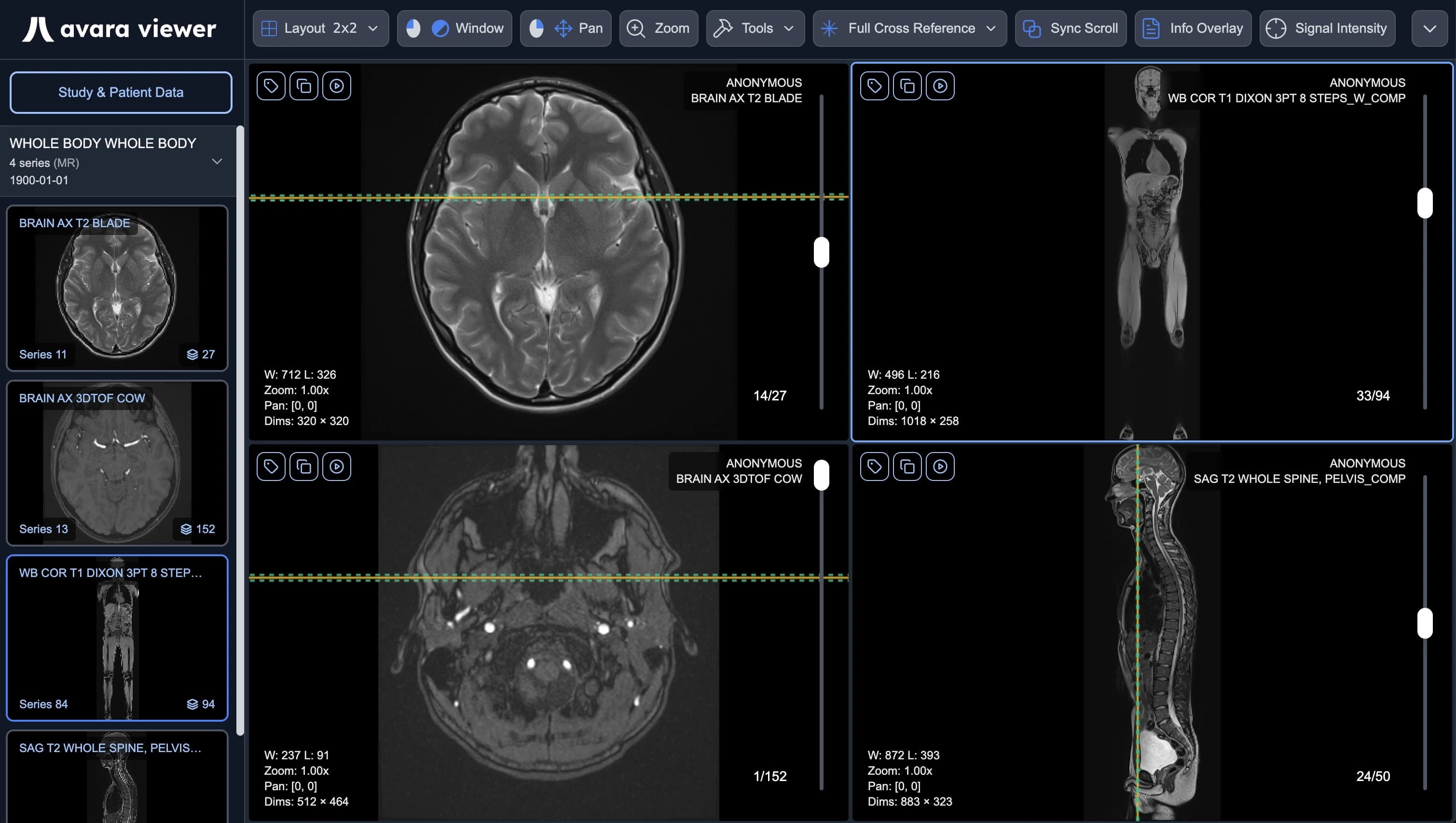
We built a diagnostic viewer from scratch because existing options were too slow, too clunky, or too expensive. We made it GPU-optimized for zero-lag interaction. We included it free with the platform because viewing shouldn't be a profit center; it should just work.
Every piece of Avara exists because we needed it to exist. Not because a product manager thought it would look good on a feature comparison chart, but because a real clinic needed it to deliver real care.
Expanding Access
The Clinical Platform solves the problem we originally faced: everything unified, no integrations required. But we realized that not every organization needs to replace their entire stack. Many PACS and RIS companies have built solid platforms – what they're missing is modern dictation or a viewer that doesn't feel like a relic.
So we built AutoScribe and the Avara Viewer as standalone products, designed from the ground up for seamless integration. Clean APIs. Developer-friendly SDKs. Documentation that actually makes sense. The goal: let any platform offer best-in-class dictation and viewing to their customers without building it themselves.
This isn't about competing with PACS and RIS vendors. It's about partnering with them.
When a platform integrates AutoScribe, their radiologists get AI-powered dictation that makes them faster and more accurate. When they embed the Avara Viewer, their users get sub-second 3D rendering and zero-lag interaction. The platform elevates its offering. The radiologists get better tools. Everyone wins.
We built these standalone products to reach as many radiologists as possible – because the mission isn't just about Avara customers. It's about fixing healthcare software wherever it's broken.
The Mission
Today, Avara serves customers across the country. Some use the full Clinical Platform. Others integrate AutoScribe or the Viewer into their existing workflows. We meet customers where they are.
But the mission hasn't changed since those 80-hour weeks in a half-finished clinic: deliver modern, affordable software to anyone who provides care.
Healthcare technology should help physicians focus on patients, not fight with vendors. It should be intuitive enough that training takes hours, not weeks. It should be affordable enough that a new practice can actually afford it. It should be robust enough that you never have to wonder if your systems will talk to each other tomorrow.
That's what we're building. That's why we wake up every morning and write code and talk to customers and push updates and fix bugs and start again.
If you're a radiologist frustrated with dictation software that feels like it's from another era
– we built AutoScribe for you.
If you're an imaging center tired of juggling five vendors who all blame each other
– we built the Clinical Platform for you.
If you're a practice manager who's ever stayed late troubleshooting an integration that worked yesterday
– we built Avara for you.
If you're a PACS or RIS company looking to elevate your platform with modern AI-powered tools
– we built our standalone products for you.
We've been where you are. We know how it feels when the software is the obstacle instead of the enabler. And we're not going to stop until healthcare technology finally catches up with the people who use it.
Avara was founded in 2024 by Richie and Mike, who still run TrueScan in St. Petersburg, Florida. The platform that started as a workaround now serves practices nationwide. If you're ready to escape integration hell, get in touch.